Rhodochrosite: Why Colorado's State Mineral Commands Premium Prices
Walk into any serious mineral show and ask where to find the most coveted rhodochrosite on earth. The answer is almost always the same: Park County, Colorado. More specifically, a single high-altitude mine tucked into the Mosquito Range that has produced crystals that reset collectors’ expectations of what this mineral can look like.
Colorado designated rhodochrosite its official state mineral in 2002 — a recognition that was long overdue. No other source on the planet has consistently produced rhodo of this quality, and the market reflects it. Understanding why requires a trip into both geology and history.
What Is Rhodochrosite?
Rhodochrosite is a manganese carbonate mineral — MnCO₃ in chemical notation — that forms in hydrothermal veins, often alongside silver, lead, zinc, and copper sulfides. Its name comes from the Greek for “rose-colored,” which describes the most prized specimens perfectly: a saturated, hot pink to cherry red that doesn’t look like it belongs in a mine.
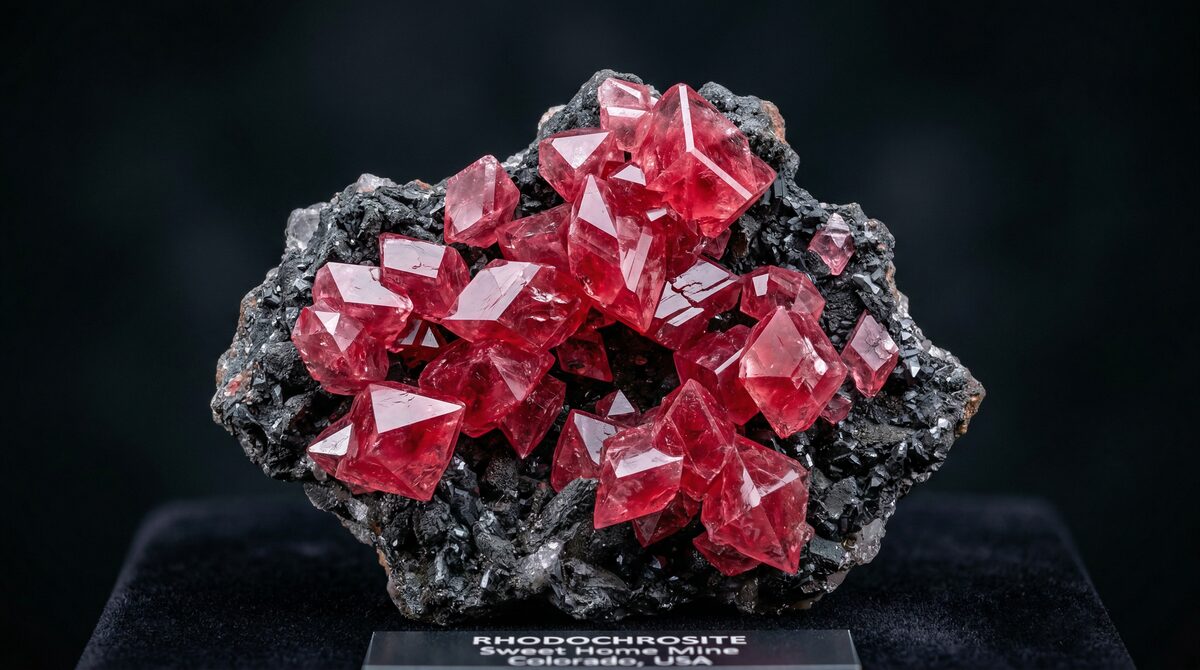
The mineral also occurs in massive form, a banded material quarried in Argentina that’s commonly cut into decorative objects. Beautiful, certainly. But it is not what collectors are talking about when they say “Colorado rhodochrosite.” That phrase means one thing: transparent to translucent crystals with faces sharp enough to cut glass, from the Sweet Home Mine.
Crystal Form and Habit
Rhodochrosite crystallizes in the trigonal system, typically forming scalenohedral or rhombohedral crystals. The Sweet Home material is famous for producing large, well-terminated rhombohedrons — blocky, stacked crystals with a luster that ranges from vitreous to resinous. The best examples are gemmy, meaning you can see light passing through them, and their color is saturated throughout the crystal, not just surface-deep.
The Sweet Home Mine: Park County’s Crown Jewel
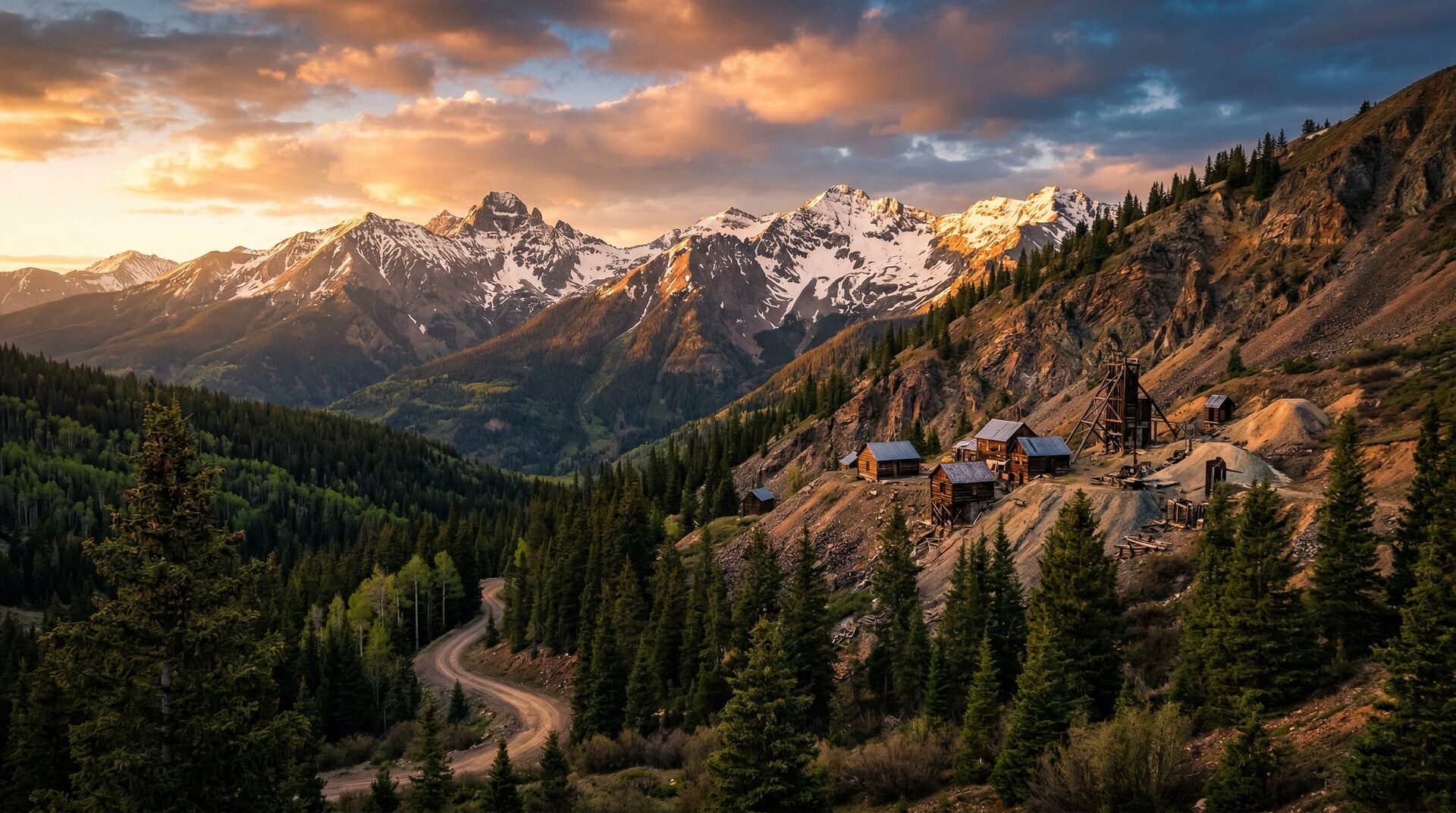
The Sweet Home Mine sits at roughly 12,500 feet elevation on Horseshoe Mountain, above the old silver-mining town of Alma. The mine was originally worked for silver in the late 1800s — the rhodochrosite was a nuisance gangue mineral to the original miners, something in the way of the ore they were after.
That attitude began to shift in the twentieth century as the mineral collecting market matured. By the 1960s, collectors were specifically targeting the Sweet Home for specimens. When serious commercial mining resumed in the late 1970s under the ownership of Bryan Lees and partner John Soule, rhodochrosite became the primary product — not silver, but crystals.
The Alma King and Museum Masterpieces
The mine has produced a handful of specimens so exceptional they’ve entered the canon of mineral collecting. The Alma King — a cluster of rich red crystals on white matrix, measuring over 11 inches across — is widely considered the finest rhodochrosite specimen ever found. It resides at the Denver Museum of Nature and Science and has been appraised at values exceeding $500,000.
Other Sweet Home pieces have sold at major auction houses for figures that would surprise anyone who thinks of minerals as a hobbyist pursuit. A pristine, gemmy, cherry-red crystal cluster with good matrix can command $10,000 to $50,000 depending on size, color, and clarity. Truly exceptional pieces go well beyond that.
What Collectors Look For: Grading Colorado Rhodo
If you’re shopping for Colorado rhodochrosite — or lucky enough to be pulling it from the ground — understanding what separates a valuable specimen from an ordinary one matters. Here’s how experienced collectors evaluate material.
Color
Color is king. The Sweet Home Mine’s most prized material is a deep, saturated cherry red or hot pink — not the pale rose or washed-out salmon you see in lesser specimens. Color should be consistent through the crystal, not faded at edges or concentrated only in the core. Stones that transition from pale pink at the base to deep red at the termination are called “color-zoned” and are prized in their own right, but uniform deep color commands a premium.
Clarity and Transparency
The best crystals are transparent to translucent. Hold a good Sweet Home rhombohedron up to a light source and it glows. Inclusions, fractures, and clouding reduce value, though a crystal with a perfect termination and single included zone is often still highly collectible.
Crystal Development
Sharp, well-defined faces and crisp terminations are critical. A crystal with chipped or worn faces — “cleaved” in collector parlance — loses significant value. Look for crystals that are complete, meaning no significant damage to the termination or primary faces.
Matrix
Most serious collectors prefer crystals “in matrix” — still attached to the host rock, which provides natural context and stability for display. Sweet Home specimens typically come on white quartz or calcite matrix. The matrix should complement the crystals without overwhelming them. A gorgeous cluster on a large, visually balanced matrix slab will sell for substantially more than the same crystals loose.
Size
Larger is generally better, but not at the expense of the other criteria. A 3-inch crystal of exceptional color and clarity outvalues a 6-inch crystal that’s pale and included. Collectors use the phrase “miniature” (roughly 1-3 inches), “small cabinet” (3-4.5 inches), and “large cabinet” (4.5+ inches) to categorize specimen size.
Why Colorado Rhodo Is Different
The Sweet Home Mine’s exceptional output comes down to geology. The Mosquito Range was subject to a specific sequence of hydrothermal activity in which manganese-rich fluids filled fractures in the surrounding limestone and quartzite host rock under the right temperature and pressure conditions to precipitate large, well-formed crystals.
The mine’s irregular “pockets” — open vugs in the vein system — protected crystals during their formation, allowing them to grow without interference. When a fresh pocket is opened, it can reveal hundreds of perfectly formed crystals that have been undisturbed for millions of years. That’s the magic: not just good geology, but preserved geometry.
Other Colorado localities have produced rhodochrosite — the John Reed Mine in Clear Creek County, various Leadville-area deposits — but none with the consistency or quality of the Sweet Home. When you see “Colorado rhodochrosite” on a label, the assumption is Sweet Home unless otherwise noted.
Pricing: What the Market Says
The rhodochrosite market is a real market, with auction records and established dealer pricing that allows for genuine comparison. As rough benchmarks:
- Thumbnail and miniature specimens (under 2 inches, good color): $50–$500
- Small cabinet specimens (good color, transparency, matrix): $500–$5,000
- Large cabinet, exceptional quality: $5,000–$50,000+
- Museum-grade masterpieces: Six figures and beyond
Prices have trended upward over the past two decades as the Sweet Home’s production has slowed and collector demand — particularly from Chinese and European collectors — has grown. Material that sold for $2,000 in 2005 may fetch $8,000 today.
Adding Colorado Rhodochrosite to Your Collection
Whether you’re a seasoned collector or just discovering what Colorado’s geology has to offer, rhodochrosite is one of the benchmarks. There are few minerals that so perfectly combine visual drama with geological rarity.
Browse our current selection of Colorado mineral specimens, including rhodochrosite material and other Rocky Mountain classics. If you’re more interested in getting into the field yourself, our prospecting guide covers where to start and what to bring.
The mountains still have secrets. Some of them are pink.