Cripple Creek Gold Tellurides: The Ore That Fooled Early Prospectors
When Bob Womack found his first piece of float in Poverty Gulch in 1890, he was looking at gold. He just couldn’t see it. Most of the people who walked across the Cripple Creek district before him couldn’t see it either. The gold was hiding in plain sight inside one of the strangest ore systems in North America.
This is the story of why Cripple Creek’s gold wasn’t gold, why early prospectors threw fortunes onto the waste pile, and why the district still produces hundreds of thousands of ounces of gold every year.
A Volcano in the Wrong Place
Most Colorado gold lives in quartz veins inside Precambrian granite. The Colorado Mineral Belt formed those deposits during the Laramide orogeny, 70 to 40 million years ago, when the western edge of North America was being shoved up into the Rocky Mountains. By the time the 1859 gold rush hit, prospectors knew what they were looking for: white quartz veins cutting through old basement rock.
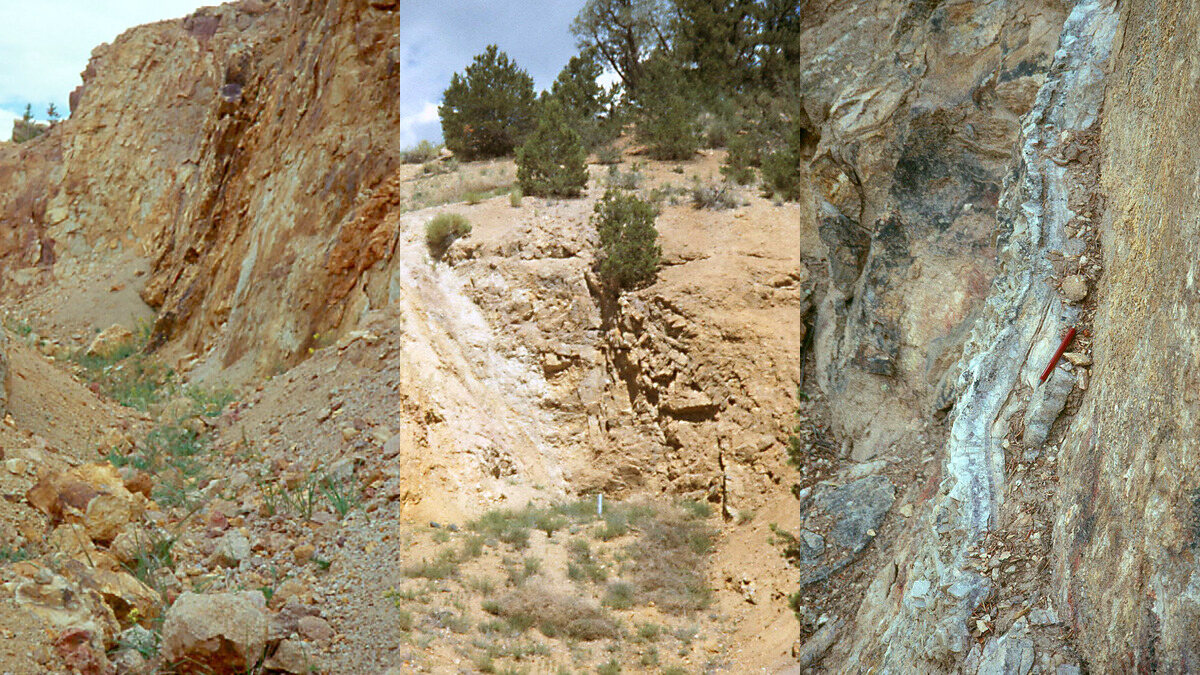
Cripple Creek doesn’t fit. The district sits on top of a volcanic diatreme that erupted roughly 32 to 28 million years ago, long after the main mineral belt deposits formed. A diatreme is what happens when magma hits groundwater near the surface: explosive eruptions blast through the crust, leaving a steep-walled crater filled with broken rock, volcanic breccia, and intrusive dikes. The Cripple Creek diatreme is about three miles across and sits on the western flank of Pikes Peak.
After the explosive phase ended, alkalic magma kept rising through the breccia, forming dikes and small intrusions of phonolite and related rocks. Hydrothermal fluids carrying gold, silver, tellurium, fluorine, and other elements moved up through fractures and breccia zones. Where they cooled, they precipitated metals onto every available surface.
This is an epithermal deposit, formed at relatively shallow depths and low temperatures (50 to 300 degrees Celsius). The deposition may have lasted up to two million years. The result: high-grade veins of gold-telluride minerals, cutting through volcanic rock and breccia, often where dikes and intrusions intersect older fractures.
What Telluride Minerals Actually Are
Tellurium is a metalloid that bonds readily with gold and silver. At Cripple Creek, the gold is mostly locked into telluride compounds rather than occurring as native metal. The main ones documented in the district:
- Calaverite (AuTe₂) — gold telluride, contains roughly 40 percent gold by weight
- Sylvanite ((Au,Ag)₂Te₄) — gold-silver telluride, around 24 to 30 percent gold
- Krennerite ((Au,Ag)Te₂) — gold-silver telluride, around 35 percent gold
- Petzite (Ag₃AuTe₂) — silver-rich gold telluride
- Nagyagite (Pb₅Au(Sb,Bi)Te₂S₆) — a complex lead-gold telluride
These minerals show up in narrow veins along with quartz, fluorite, and pyrite. Native gold exists at Cripple Creek too, but it’s the exception rather than the rule.
Why Prospectors Missed It
Native gold has a distinctive look that nobody confuses with anything else: deep yellow, soft, heavy, doesn’t tarnish. Tellurides look nothing like that.
Calaverite is silver-white to brass-yellow with a metallic luster. Sylvanite is steel-gray to silver-white. Krennerite is silvery-white. To an experienced prospector running a pan in 1890, these minerals looked like worthless metallic sulfides — maybe arsenopyrite, maybe a strange variety of pyrite, maybe a lead-bearing mineral. They were heavy, but heaviness alone doesn’t pay the assayer.
Worse, the tellurides don’t free-mill. Crush them, run them through a sluice or a stamp mill, and the gold won’t drop out. The gold is chemically bonded to the tellurium and stays locked in the mineral grain. A miner working a Cripple Creek vein with traditional placer or stamp-mill techniques would see almost nothing in their concentrate even when they were standing on bonanza ore.
Several stories from the early 1890s describe miners discarding telluride-rich rock as worthless. Some of those waste piles were later reprocessed at significant profit once the district understood what it had.
The breakthrough was assaying. When a sample was sent to a competent assayer who knew what to look for — and who could either fire-assay the rock or roast it to drive off the tellurium — the gold values came back high. Once that was established, miners started “roasting” their ore: heating it to volatilize the tellurium, leaving behind blistered, vesicular crusts of nearly pure gold. Those roasted specimens are collectible today, with the gold appearing as porous yellow crusts on the original telluride matrix.
The Boom That Followed
Once the district figured out its own ore, things moved fast. Bob Womack’s January 1891 vein triggered a stampede. Winfield Scott Stratton staked the Independence claim on July 4, 1891, on Battle Mountain. Within three years, more than 150 mines were operating across the district. By 1900, annual gold production had reached $50 million at the prices of the day.
The labor history followed. The Cripple Creek strike of 1894 was a five-month dispute that ended in a rare victory for the Western Federation of Miners — partly because Governor Davis Waite ordered the state militia in support of the strikers, the only time in U.S. history that’s happened. The 1903 to 1904 strike, part of the Colorado Labor Wars, was bloodier and went the other way.
Through it all, the tellurides kept producing. The district has yielded over 21 million ounces of gold to date and is still actively mined.
What Telluride Specimens Look Like
Cripple Creek telluride specimens are recognizable to mineral collectors. Calaverite typically forms striated, blade-shaped crystals or thin platy aggregates with a metallic silver-yellow color. Sylvanite forms elongated prismatic crystals or skeletal aggregates with a steel-gray color, often with a brighter silver-white luster on fresh fracture surfaces. Both are heavy, brittle, and tend to occur in narrow vein zones with quartz, fluorite, and dark phonolite host rock.
Roasted ore is a different beast: golden vesicular crust on the original gray telluride, like a metallic pumice. Those pieces are made specifically as collector items today — the chemistry doesn’t change the value, just the appearance.
Visiting Today
The Cripple Creek and Victor area remains one of the best places in Colorado to see active and historic mining together. The Cripple Creek Heritage Center has free exhibits covering the geology and mining history. The Cripple Creek District Museum on Bennett Avenue holds artifacts and mineral specimens from the boom era, including telluride pieces. The Mollie Kathleen Gold Mine, which offered underground tours for decades, is currently closed for the foreseeable future — check ahead before planning a trip around it.
The Newmont-operated Cripple Creek and Victor Gold Mine still pulls roughly 330,000 ounces of gold per year from the same caldera system, mostly through open-pit and heap-leach methods that work the oxidized upper portions of the old ore bodies. You can see the modern operation from public roads and overlooks.
A few practical notes:
- Don’t enter abandoned workings. The district has thousands of unmarked old shafts, adits, and stopes. Bad air, rotten timbers, and unstable ground have killed people here. Stay on roads and marked trails.
- Most ground is private or claimed. The Newmont operation covers a large footprint, and many surrounding parcels are private property or active mining claims. Don’t assume open land is open to collecting.
- Specimens still come out of the district. Reputable mineral dealers occasionally have authentic Cripple Creek telluride material. Provenance matters — calaverite has been faked, and roasted specimens are sometimes misrepresented.
For the broader story of how Cripple Creek fits into Colorado’s mining timeline, our Cripple Creek and Victor gold rush post covers the boom years and the modern operation in more detail. Our Mining Guide breaks down the legal framework around claims and collecting in Colorado.
Questions about Cripple Creek mineralogy or visiting the district? Get in touch.