Mining the San Juan Mountains: A Rich and Rugged History
There are places in Colorado where the mountains feel ordinary. The San Juan range is not one of them. The peaks are higher, steeper, and more dramatic than most of the Rockies — a mass of volcanic rock piled on ancient basement, carved by glaciers, and shot through with some of the richest ore deposits in North American history.
Between 1870 and 1920, the San Juan Mountains produced hundreds of millions of dollars in silver and gold. The towns that grew to extract those metals — Silverton, Ouray, Telluride, Lake City, Creede — are among the most storied in Colorado’s history. Understanding how those deposits formed, how they were discovered, and why the industry ultimately declined tells you everything about what the San Juans are and why they still draw prospectors, collectors, and history-seekers today.
The Geology of San Juan Mineralization
The San Juan Mountains are geologically young and geologically violent. The underlying basement rocks are ancient — the Precambrian metamorphic core exposed at the heart of the Uncompahgre Plateau is over 1.7 billion years old. But the mountains as they now exist are largely the product of Tertiary-age volcanism, beginning roughly 35 million years ago and continuing in multiple phases until about 23 million years ago.
The San Juan Volcanic Field
The San Juan Volcanic Field is one of the largest exposed volcanic systems in North America, covering roughly 25,000 square miles in what is now southwestern Colorado and northern New Mexico. Multiple eruption events deposited thick sequences of ash-flow tuffs, lavas, and volcanic breccias that buried and altered the earlier terrain.
These volcanic rocks are the host and heat source for most of the San Juan’s ore deposits. Hot magmatic fluids moved through the fractured volcanic pile, depositing gold, silver, and base metal sulfides in veins and replacement zones throughout the volcanic stratigraphy.
Calderas: Nature’s Ore Factories
The most significant single geological feature driving San Juan mineralization is the presence of multiple calderas — collapse structures formed when volcanic magma chambers emptied and the overlying rock subsided. Calderas create ring fracture systems that become highly permeable pathways for hydrothermal fluids.
Several major calderas have been mapped in the San Juans: - Silverton Caldera — The ring fracture system around the caldera margin hosts the epithermal vein systems that made Silverton and Ouray famous - San Luis Caldera - Creede Caldera — Still expressed in the landscape at Creede; the ring fracture produced the Creede mining district, famous for silver ore and still-attractive mineral specimens
The Silverton caldera’s ring fracture is directly responsible for the concentration of ore at Ouray, Silverton, and the Red Mountain district. Understanding this structure — visualizing the volcanic edifice and where its fractures ran — explains why so many mines crowd such a relatively small area.
The Major Districts
Silverton and the Red Mountain District
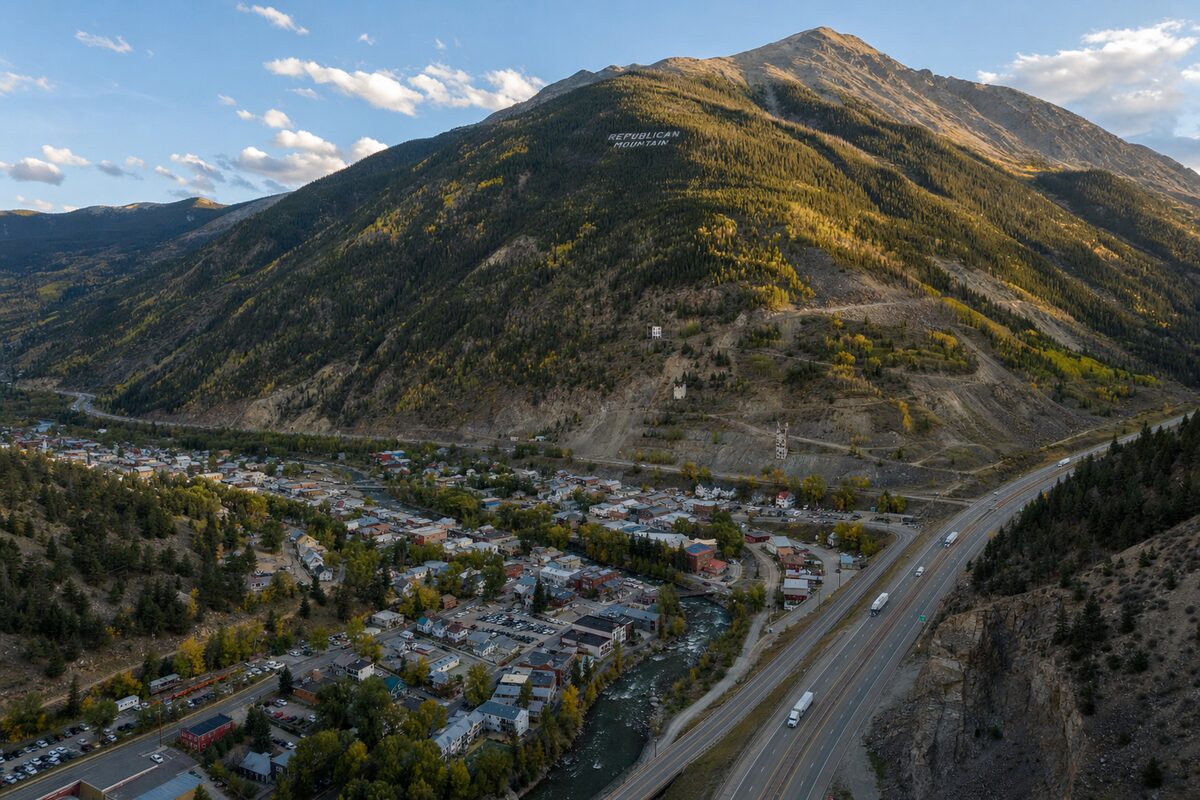
Silverton, in San Juan County, sits at 9,318 feet in a glaciated valley surrounded by fourteen-thousand-foot peaks. It was never a quiet place. The town grew from nothing in the 1870s as silver ore from the surrounding mountains flowed through its mills and smelters.
The Red Mountain district, reached by the million-dollar highway (today’s US Highway 550) between Silverton and Ouray, was among the most productive in the state. The red and orange color of Red Mountain itself reflects iron-oxide staining from heavily oxidized pyrite — the classic gossan that indicates sulfide ore beneath. The mines of the district produced silver, gold, lead, and copper in quantities that funded fortunes in Denver and New York.
The Idarado Mine, which consolidated many Red Mountain properties in the twentieth century, operated until 1978 and processed ore from nearly 100 miles of underground workings.
Ouray: The Switzerland of America
Ouray, ten miles north of Silverton over Red Mountain Pass, earned its “Switzerland of America” nickname honestly — the town sits in a near-vertical box canyon that looks like something an illustrator would invent. The surrounding mountains hold dozens of historic mines, many still accessible by jeep trail.
The Sneffels mining district, southeast of Ouray near Mount Sneffels, produced substantial gold and silver ore through the late nineteenth and early twentieth centuries. The Camp Bird Mine — discovered by Thomas Walsh in 1896 when he recognized the telluride ores that previous owners had dismissed — produced $3 million in gold by 1902 and was sold to a British syndicate for $5.2 million. Walsh used the proceeds to become one of Washington D.C.’s most prominent socialites; his daughter, Evalyn Walsh McLean, eventually owned the Hope Diamond.
Telluride: Gold and Altitude
Telluride, in the San Miguel watershed on the far western San Juans, began its mining career with the Sheridan and Tomboy mines in the 1870s and grew into one of the most productive gold districts in the state. The Smuggler Union Mine, the Liberty Bell, and the Tomboy all contributed to production exceeding $60 million in gold and silver during the district’s productive years.
Telluride’s remote location — accessible by only a narrow-gauge railroad and switchback wagon roads before the automobile era — meant that labor costs were high and labor conflicts were intense. The town was the site of one of the most violent episodes of the early labor movement in the West, when disputes between the Western Federation of Miners and mine owners turned to dynamite and state militia deployments in the early 1900s.
Lake City and the Lake Fork
Lake City, in Hinsdale County, has a distinctly different character from the more famous San Juan mining towns. Smaller, more isolated, with a Victorian-era downtown preserved almost intact, it developed around the Ute-Ulay Mine and related properties in the Lake Fork valley.
Hinsdale County is also home to one of American history’s strangest and most grim episodes: Alferd Packer, convicted of killing and cannibalizing five companions in the San Juan mountains in 1874, was sentenced at Lake City. The courthouse where he was sentenced still stands.
Creede: Silver in the Cliffs
Creede, in Mineral County at the southern edge of the San Juans, was the last of Colorado’s great silver boom towns. When Nicholas Creede discovered rich silver ore in the Willow Creek canyon in 1890, it set off a rush that added 10,000 people to a valley that had contained almost none.
The town was rough, crowded, and theatrical. Bat Masterson ran the Denver Exchange saloon. Bob Ford — the man who shot Jesse James — was himself shot and killed in Creede in 1892. Cy Warman’s poem “And There Is No Night in Creede” described the feverish, around-the-clock character of the boom.
When the silver crash of 1893 hit, Creede collapsed as quickly as it had risen. The Wheeler Geologic Area, accessible from Creede, showcases the bizarre eroded volcanic formations of the region and rewards the visitor who makes the effort to reach it.
Ghost Towns and Living Landscape
Most of the San Juan mining towns are substantially or completely gone. Sneffels, Albany, Eureka, Animas Forks — these were thriving communities that are now ruins in the hills, accessible by 4WD roads that follow the old pack trail and wagon road routes.
Animas Forks — at 11,584 feet in the upper Animas valley above Silverton, this was a year-round community in the 1880s despite winters that regularly dumped 20-foot snowpacks. The ruins of the town hall, the jail, and several substantial residences survive and are maintained by the BLM as a historic site.
Eureka — Another upper Animas community, the site of the Sunnyside Mill, which continued operating into the twentieth century. The remains of the mill’s concrete foundations are visible from the road.
Mineral Point — High above Ouray on the Engineer Pass road, this tiny camp served mines on the plateau. The American Flats above it are one of the most visually striking mining landscapes in Colorado — vast, treeless, scattered with the ruins of mining activity against a backdrop of peaks.
The San Juans for Prospectors and Collectors Today
The San Juan Mountains offer opportunities for both historical research and active prospecting.
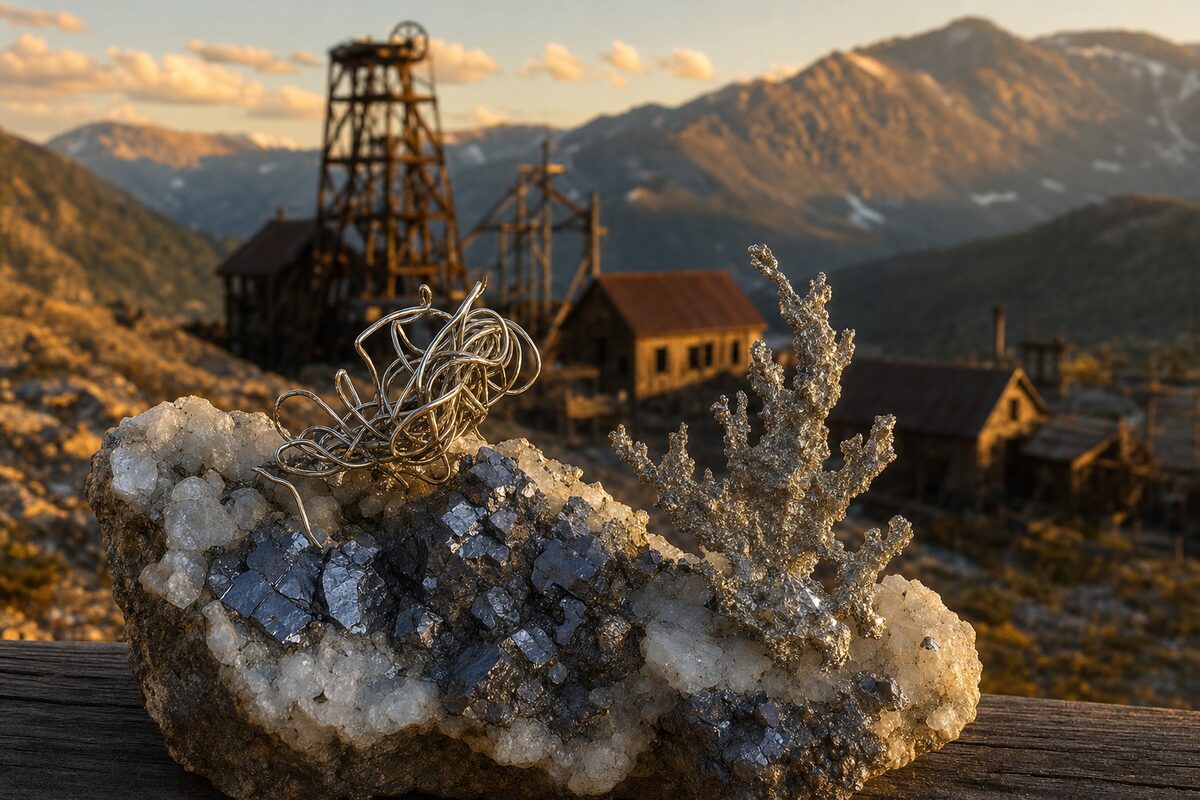
Rockhound collecting: The volcanic host rocks and hydrothermal systems of the San Juans have produced exceptional mineral specimens — rhodochrosite, pyrite, stibnite, calaverite, various silver sulfosalts. Many Creede-area minerals appear regularly at mineral shows.
Active claims: Significant portions of the San Juans remain open to mineral entry. Research specific areas carefully — the Weminuche Wilderness prohibits new claims, and some areas have specific management restrictions.
4WD access: The Alpine Loop, the Engineer Pass road, and dozens of other routes provide access to historic mining country that rewards exploration. Know your vehicle’s capabilities and respect road closures.
The San Juans built fortunes, broke men, and created one of the most dramatic human landscapes in the American West. The geology that made all of it possible is still there, still readable in the iron-stained rock and quartz-veined outcrops if you know what you’re looking at.
Browse our Colorado mineral specimens for examples of what the San Juans and the broader Colorado Mineral Belt produce. Ready to explore your own claims? The mining claims guide walks you through the process. And if you want to plan a prospecting trip to the region, the prospecting guide has you covered.
These mountains don’t give up their secrets easily. That’s what makes them worth knowing.