Essential Prospecting Equipment for Colorado Mountains
Colorado prospecting isn’t a casual hobby. The mountains are high, the weather turns fast, the terrain is rough, and the ground doesn’t give up anything to someone who shows up unprepared. The right gear makes the difference between a productive day and a miserable one — and between finding gold and leaving it behind.
This list covers what you actually need for Colorado conditions: the gold pan, the classifier, the sluice, the rock tools, and the safety gear that keeps you coming back. No fluff, no gadgets that look good in a catalog but break in the field.
Placer Equipment: Working the Water
Placer prospecting — recovering gold from alluvial gravel in streams and banks — requires a specific set of tools built around controlling water and concentrating heavy minerals.
The Gold Pan
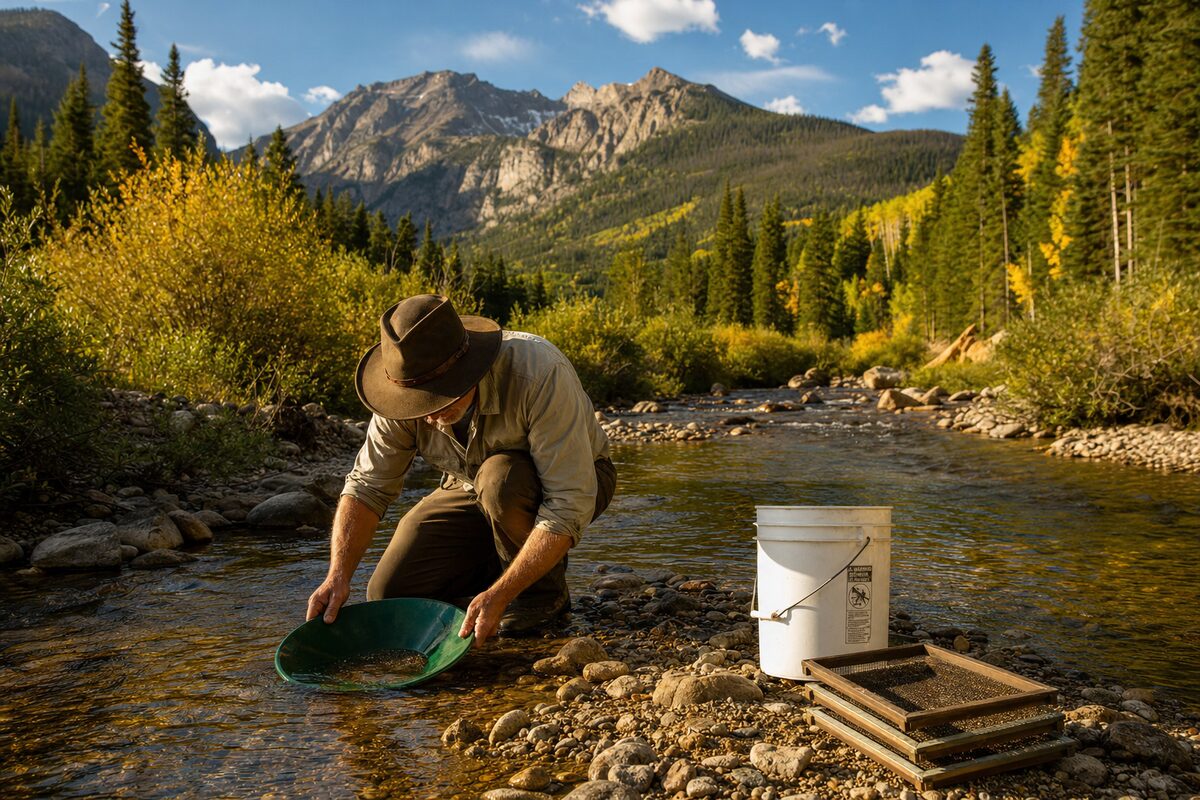
Your gold pan is your primary sampling tool. Everything else in your kit is about processing volume; the pan is about evaluating what you’ve found. A good pan will tell you whether a spot is worth working with a sluice, and it’s the final step in cleaning your concentrates down to pure gold.
Material: Plastic pans dominate the modern market for good reason. They’re lightweight, don’t rust, and the dark green or black color provides contrast against gold. Steel pans work but require seasoning to prevent rust and are heavier to carry.
Size: A 14-inch pan is the standard workhorse. Smaller pans (10-12 inch) are good for fine sampling work and finishing concentrates. Some panners keep a large 16-inch for initial testing and a smaller pan for cleanup.
Riffle design: Most quality plastic pans have molded riffles — angled ridges that help trap heavy minerals during the swirling process. Hungarian, spiral, and flat-bottom riffles each have advocates. Try a few and find what works with your technique.
Quality pick: Garrett, Keene, and Proline all make reliable pans in the $15–$30 range. At this price point, there’s no reason to compromise.
The Classifier
A classifier is a sieve — a screen in a ring that fits over your bucket or pan. Its job is to screen out oversize material before it goes in the pan, dramatically speeding up the concentration process.
Colorado mountain streams often carry a lot of coarse gravel and cobbles. Running a classifier step before panning saves time and protects your pan from heavy cobbles that can wear the riffles.
Screen size: 1/2-inch and 1/4-inch classifiers are standard. Many prospectors use the 1/2-inch first, then run the classified material through a 1/8-inch or finer screen before panning. Colorado’s fine gold — common in the mountain drainages — doesn’t need to be screened out fine, but removing large material helps.
The Sluice Box
A sluice box is the volume-processing engine of placer prospecting. While a gold pan can process a few pounds of gravel per session, a sluice box can run hundreds of pounds per hour. Set it in a creek with proper slope, shovel material in the top, and let water do the work of separating heavy gold from light gangue.
Length: 30–50 inches is the practical range for one-person portable sluicing. Longer sluices recover more fine gold but are heavier to carry into remote areas.
Riffle design: Expanded metal and Hungarian (angle iron) riffles are the two classics. Many sluices combine both. A layer of indoor/outdoor carpet or miners’ moss under the riffles helps trap very fine gold that might wash over the top.
Setup matters: Slope is critical. Too steep and gold washes through with the gangue; too flat and the sluice bogs down. A 1–2 inch drop per running foot is a common starting point — adjust based on water flow and material.
Portability: For Colorado mountain prospecting, you’ll often be packing gear some distance from the vehicle. A foldable or modular sluice that breaks into sections is worth the extra cost.
High Banker/Power Sluice
A high banker pumps water from the creek to a riffle box above the waterline, letting you work gravels on banks where setting a gravity-fed sluice isn’t possible. For Colorado bench gravels and high-bank placer operations, this significantly expands your working area.
These are heavier and more complex to set up, but experienced prospectors working productive areas often consider them essential.
Suction Dredge Considerations
Suction dredges — gasoline-powered units that vacuum up creek gravel and run it through an onboard sluice — are the most productive placer equipment available to the individual prospector. They are also the most regulated.
Colorado regulations: Dredging in Colorado requires permits from the Colorado Division of Reclamation, Mining and Safety (DRMS) and must comply with water quality standards. Some streams prohibit dredging entirely during certain seasons to protect fisheries. Research all permit requirements before operating a dredge. The penalties for unpermitted dredging are serious.
Hard Rock Equipment: Reading the Ledge
Colorado’s gold and mineral wealth isn’t all in the creeks. A significant proportion is locked in quartz veins and mineralized outcrops in the hillsides — lode deposits that require a different approach.
Rock Hammer
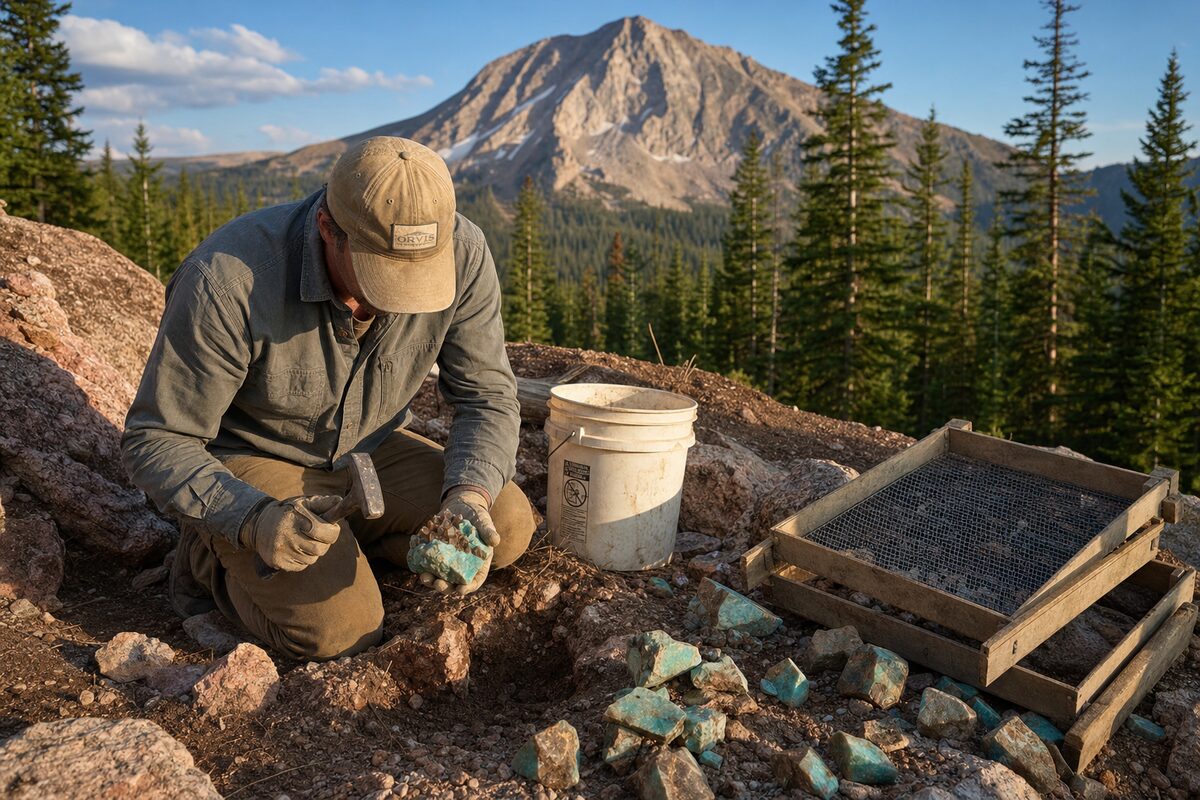
The workhorse of hard-rock prospecting. A standard geologist’s pick — one end pointed, one end flat (the hammer face) — is the starting point. Look for high-carbon steel heads and a fiberglass or hickory handle that won’t shatter under hard use.
Weight: 22–32 oz is the standard range. Heavier hammers break rock more effectively; lighter ones are easier to swing all day. Most field prospectors land on 22–26 oz.
Always wear eye protection when swinging a rock hammer. Rock chips travel fast and far.
Cold Chisels
For extracting mineralized veins from surrounding matrix, cold chisels let you place force precisely. Keep a set — small (3/8” tip), medium (5/8"), and large (3/4” and above) — to handle different situations. A moil point chisel is useful for breaking into solid rock.
Replace chisels when the striking end mushrooms. A mushroomed chisel head can throw sharp metal chips.
Pry Bar and Hand Sledge
A 3–4 lb hand sledge pairs with chisels for any serious excavation work. A small pry bar helps crack open rock sections and move boulders when you’re working a productive area. These are heavy items — weigh the tradeoff between capability and pack weight for your specific trip.
Loupe and Hand Lens
A 10x hand loupe is the prospector’s microscope. Use it to identify minerals in your samples, examine quartz vein texture, and evaluate whether that yellow color is gold or pyrite (fool’s gold).
The pyrite test: Pyrite is brassy yellow and breaks with rough, blocky fracture faces. Gold is a warmer, more yellow color, bends without breaking, and is malleable — you can flatten it with a pin. Under a 10x loupe, these differences are obvious.
Safety and Support Gear
Colorado’s mountains demand respect. A gear failure or weather event can become life-threatening above treeline, and many productive prospecting areas are miles from the nearest trailhead.
Navigation
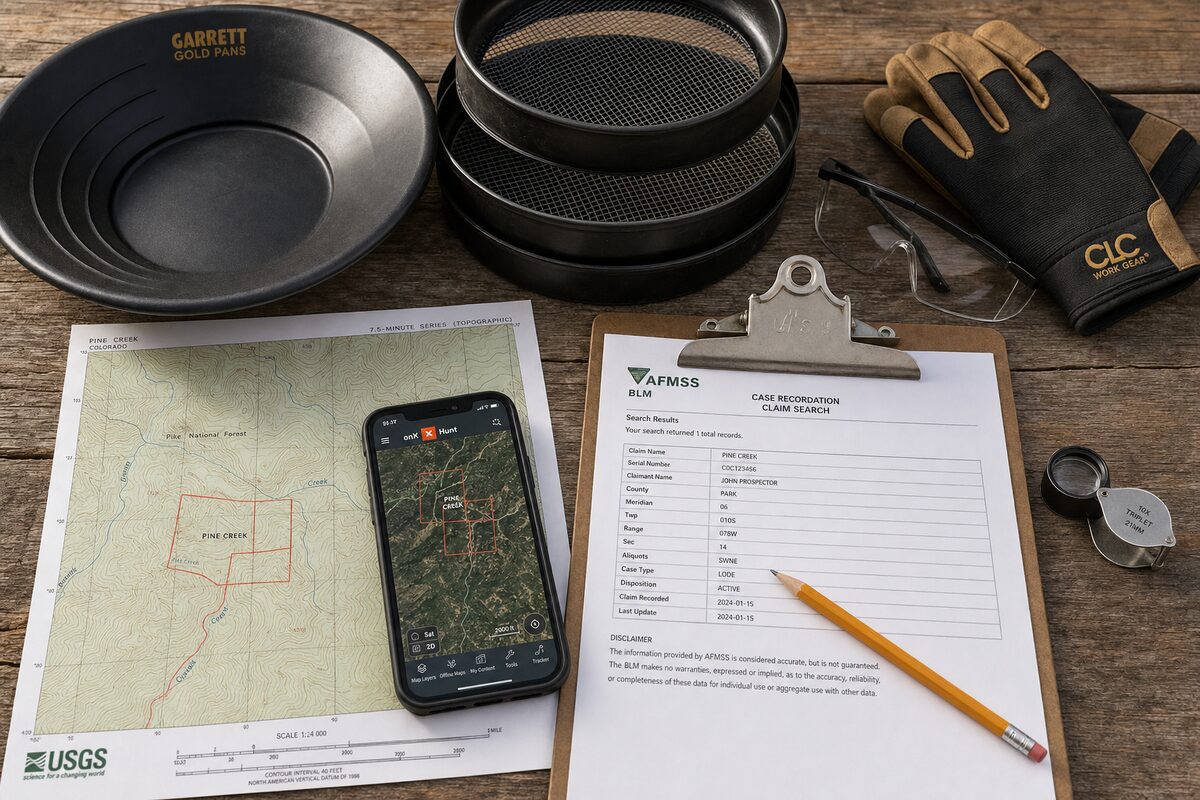
A topographic map and compass are baseline requirements. Paper maps don’t run out of battery. A GPS unit or GPS-capable smartphone with offline maps (Gaia GPS and CalTopo are both excellent) adds capability and redundancy.
Colorado’s geological and topographic maps — available through the USGS and the Colorado Geological Survey — are invaluable for pre-trip research.
Hydration and Nutrition
Working in mountain creeks and steep terrain is physically demanding. At altitude, dehydration creeps up faster than you expect. A minimum of 3 liters of water capacity, plus a water filter for extended trips. High-calorie snacks that don’t require preparation.
Weather Protection
The Colorado mountain weather rule: afternoon thunderstorms happen. Plan to be off exposed ridges and above-treeline terrain by noon or 1 PM. Always carry a rain shell. Temperature can drop 30 degrees in minutes when a storm rolls in.
First Aid Kit
A compact wilderness first aid kit sized for the number of people in your party. Include blister treatment (a certainty on rocky creek work), wound care, and any personal medications.
Communication
Above treeline, cell service is unreliable at best. A personal locator beacon (PLB) or satellite communicator (Garmin inReach, SPOT) is worth the investment for any solo or remote prospecting.
Organizing and Transporting Your Take
Whatever you recover needs to get home intact.
Specimen storage: Wrap delicate specimens in newspaper, toilet paper, or foam padding. Cardboard egg cartons work well for small crystals. Hard-sided plastic cases offer better protection for valuable material.
Gold storage: A small glass vial with a tight lid is the traditional gold holder. Keep it in a secure inner pocket, not loose in a pack where it can disappear in a creek.
Weight considerations: Gold is heavy. That’s the point. But a successful day of sluicing can yield a bucket of concentrates that weighs 20+ lbs. Plan your pack-out.
Ready to get equipped and get out there? Our prospecting guide covers locations, techniques, and seasonal timing across Colorado’s best districts. When you’re ready to stake your own ground, the mining claims page walks you through the entire process. And if you want to know what you’re looking for, browse our Colorado mineral specimens for reference material from the state’s most productive localities.
The mountains have what you’re looking for. Go get it.