How to File a Mining Claim with the BLM: Step by Step
You’ve done the fieldwork. You’ve prospected the area, sampled the ground, and found something worth protecting. Now you need to make it official. Filing a mining claim with the Bureau of Land Management is a specific legal process with specific deadlines, and doing it correctly from the start saves the kind of headaches that can cost you a claim you’ve worked hard to find.
This guide walks through the complete process: verifying land status, completing the physical location, filing at the county, and recording with the BLM. We’ll cover timing requirements, current fees, and the common mistakes that trip up first-time filers.
Before You Stake: Confirm the Land Is Open
The most important first step happens before you ever put a pick in the ground. Not all federal land is open to mineral entry, and staking a claim on withdrawn land doesn’t create a valid claim — it creates paperwork that will be rejected and potentially legal liability.
Using LR2000 to Check Land Status
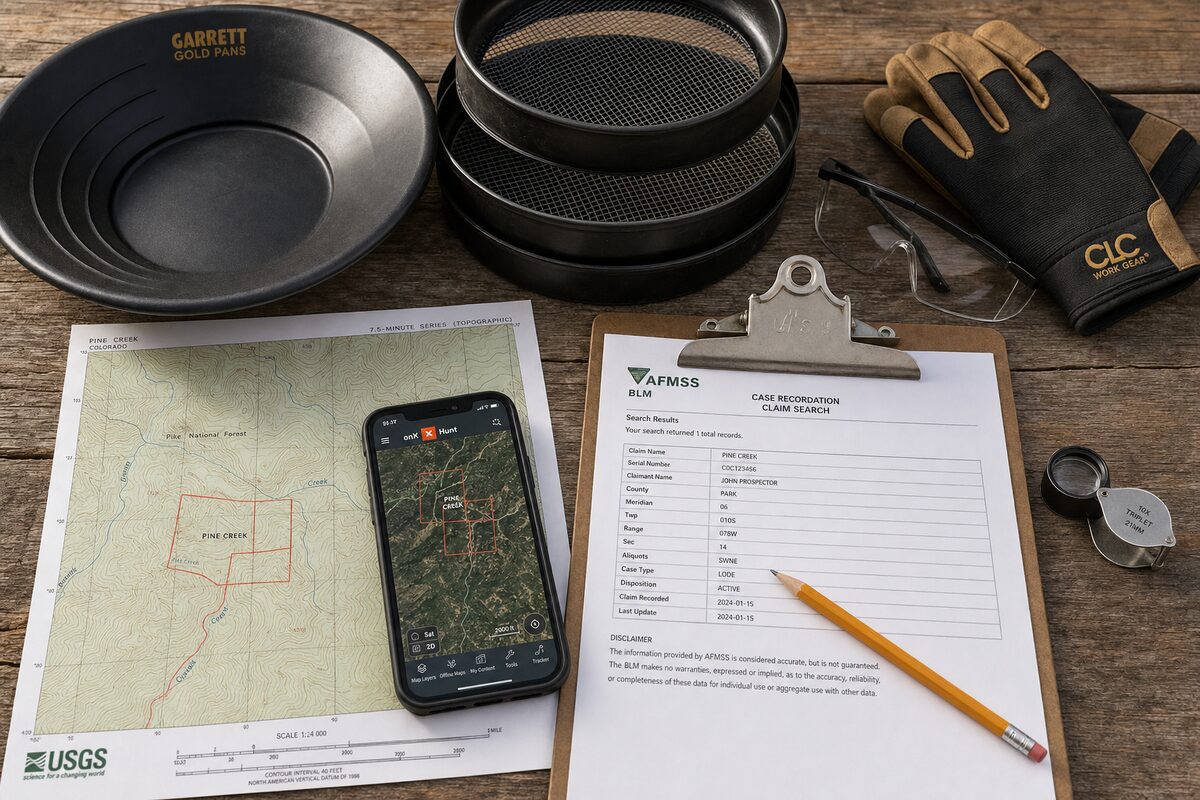
The BLM’s Legacy Rehost 2000 (LR2000) database is the authoritative record of land status, existing mining claims, and withdrawals on federal public land. It’s publicly accessible at lr2000.blm.gov.
To check a specific area: 1. Navigate to the Case Recordation Search 2. Enter the township, range, and section for your area of interest (from a USGS topographic map) 3. Review results for existing valid claims, withdrawals, and other encumbrances
What you’re looking for: - No existing valid claims covering your target area - Land status of “open” to mineral entry - No withdrawal orders that prohibit mining activity
If a prior claim exists in your area, you cannot stake over it. If the land is withdrawn, you cannot locate there. Both situations require you to find different ground.
GeoCommunicator and BLM Maps
The BLM’s GeoCommunicator (now integrated into the BLM National Viewer at blm.gov/maps) provides a visual interface showing land status, existing claim blocks, and management boundaries. It’s a useful complement to the LR2000 text database for visualizing exactly where open land is relative to existing claims and boundaries.
National Forests: Administered by the Forest Service rather than the BLM, National Forest lands are generally open to mineral entry but have their own management plans. Check with the relevant Ranger District for specific conditions.
The Physical Location: Staking Your Claim
Federal mining law requires that a claim be physically located on the ground before any paperwork is filed. The physical location — driving stakes, building monuments, posting notice — is what establishes your priority date.
Location Notice Requirements
The location notice is the document posted at your discovery monument. It must contain:
- Your full name (all locators if there are multiple)
- Date of location
- Name of the claim (you choose this — make it unique and memorable)
- Type of claim (lode, placer, millsite)
- Description of the claim boundaries sufficient to identify the location
- Reference to the nearest section corner or quarter corner of the public land survey system
- Number of feet claimed in each direction along the lode (for lode claims)
Post the notice in a weatherproof container at your discovery monument. A sealed plastic bag inside a covered metal post is the standard approach.
Monument Requirements
For lode claims: - A discovery monument at the point of discovery (or the center of the claim if no single discovery point) - Corner monuments at each of the four corners - End center stakes at the midpoint of each end line, marked with the claim name and corner designation
For placer claims: - Corner monuments at each corner - Sufficient additional markers to define the boundaries clearly on the ground
Monuments should be durable: metal posts, cairns with capped pipe, or similar permanent markers. Stakes that can be knocked over by wildlife or washed away by runoff are inadequate. In Colorado’s mountains, freeze-thaw cycles and snowpack can displace monuments over winter — inspect them each spring.
Measure carefully. Errors in monument placement that cause your claim to overlap an existing valid claim are a serious problem. Use a GPS unit, compass, and measuring tape. Document your monument coordinates.
Step 1: Record at the County Clerk
Within 90 days of the date you marked on your location notice, you must record a certificate or notice of location with the county clerk in the county where the claim is located.
What to Bring to the County Clerk
- A completed certificate of location (also called a notice of location depending on the county’s terminology), signed and notarized
- A map or sketch of the claim showing its location, boundaries, and relationship to the public land survey
- The recording fee (typically $10–$40 in Colorado; confirm with the specific county)
Contents of the Certificate of Location
Your county filing document should include all the information from your posted notice plus:
- Legal land description (township, range, section)
- Acreage of the claim
- Description of the discovery monument and corner monument locations
- A sketch or map adequate to locate the claim on the ground
- Your signature and, in Colorado, notarization
The county clerk assigns a document number, records the instrument in the county records, and returns a stamped copy. Keep this copy. It’s your proof of county recording and you’ll need it for the BLM filing.
County-Specific Requirements in Colorado
Colorado’s counties vary slightly in their exact requirements for mining claim recording. The following counties contain the most active prospecting areas and their recording offices are accustomed to mining claim filings:
- Gilpin County — Central City/Black Hawk area
- Clear Creek County — Idaho Springs, Silver Plume area
- Park County — Fairplay, South Park, Alma (Sweet Home Mine)
- Chaffee County — Salida, Buena Vista, Monarch Pass area
- San Juan County — Silverton, high San Juans
- Lake County — Leadville district
Call ahead to confirm current fees and any county-specific form requirements before your visit.
Step 2: File with the BLM
Within 90 days of location, you must also file with the BLM Colorado State Office. Both filings must happen within the 90-day window — the clock on both starts at the same moment, the date on your location notice.
BLM Colorado State Office
Mailing address for new mining claim filings:
BLM Colorado State Office
2850 Youngfield Street
Lakewood, CO 80215
In-person filing is also accepted at this office.
Documents Required for BLM Filing
- A copy of the county-recorded certificate of location (the version with the county clerk’s recording stamp and document number)
- A map clearly showing the claim location with reference to the legal land description, drawn to a recognizable scale
- The filing fee — currently $40 per claim (verify the current fee with the BLM before submitting; fees are subject to change)
Payment should be by check or money order made payable to “Bureau of Land Management.” Do not send cash.
What the BLM Does With Your Filing
The BLM reviews your filing for completeness, assigns your claim a serial number, and records it in the LR2000 database. You’ll receive a confirmation with your claim’s serial number, which is your permanent BLM identifier.
Your claim will now appear in LR2000 searches, making it visible to anyone checking the area for prior claims. This protects you from being overstaked and informs others that the ground is occupied.
Annual Maintenance: Keeping Your Claim Valid
Filing is not a one-time event. Mining claims require annual maintenance to remain valid.
The Maintenance Year and Deadline
The federal mining assessment year runs from September 1 to August 31. Annual maintenance (fee payment or assessment work) must be completed before September 1 of each year to maintain the claim for the following year.
Missing this deadline voids the claim automatically, without any notice from the BLM. There is no grace period, no warning letter, no second chance. September 1 is the deadline, every year, without exception.
Maintenance Fee
The current annual maintenance fee is $165 per claim, paid to the BLM. Payment must be received before September 1. Include your claim serial number with every payment.
BLM now accepts online maintenance fee payments through their mining claim maintenance system at pay.gov. This is the simplest and most reliable method — you receive immediate confirmation.
Small Miner Waiver Alternative
If you hold 10 or fewer claims, you may qualify for the small miner waiver, which substitutes a $5 fee plus an affidavit of assessment work for the $165 maintenance fee. The affidavit must document $100 worth of labor or improvements on the claim.
Both the $5 fee and the affidavit must be filed before September 1. The waiver must be filed at both the BLM and the county clerk.
Common Errors and How to Avoid Them
Missing the 90-Day Window
Both county and BLM filings must occur within 90 days of location. The day you stake the claim — the date on the location notice — is Day 1. Write the deadline in your calendar the moment you stake. File promptly; don’t wait for the last week.
Inadequate Monument Descriptions
Your certificate of location must describe monument locations with enough precision that someone else could find them. GPS coordinates in addition to directional descriptions are strongly recommended. Vague descriptions ("on top of the hill near the creek") create problems.
Failing to Post the Full Notice
A location notice missing required elements — date, locator names, claim type, or directional description — can be challenged. Use a checklist and verify every required element is present before you stake.
Not Checking for Prior Claims
Staking over an existing valid claim is a significant legal problem. Check LR2000 before every staking event. Check again with the county clerk. Overlapping claims require legal resolution that can be expensive and time-consuming.
Lapsed Annual Maintenance
Set a recurring annual reminder in early August: pay the maintenance fee before September 1. More claims have been lost to missed maintenance than to any other cause.
Filing a mining claim correctly takes a few hours and costs less than $200. The protection it provides — the legal right to mine a piece of ground you’ve found and evaluated — is worth considerably more. Do it right once and maintain it diligently.
For a broader overview of claim types and Colorado-specific requirements, see our complete mining claims guide. And when you’re ready to go find the ground worth protecting, start with our prospecting guide.
Good ground is out there. Now go make it yours.