Mining Claims 101 (Colorado Edition): Casual Use vs. Notice vs. Plan of Operations
The mountains don’t care how serious you are. Whether you’re dragging a gold pan through a creek on your lunch break or running a full-scale excavation above 10,000 feet, the BLM has a level of oversight that applies to you. Get it right before you break ground.
Here’s the plain-English breakdown of the three tiers of BLM surface management under 43 CFR 3809, with Colorado-specific notes on where the state’s Division of Reclamation, Mining and Safety (DRMS) enters the picture.
The Foundation: The 1872 Mining Law
The General Mining Act of 1872 is the governing law for locatable minerals — gold, silver, copper, lead, zinc, and similar hardrock deposits — on federal public lands. It gives U.S. citizens the right to prospect, locate a claim, and extract minerals without paying a royalty to the government. That’s the good part.
The catch: “the right to mine” is not the same as “the right to tear up the surface however you want.” The Federal Land Policy and Management Act of 1976 layered reclamation and permitting requirements on top. Those requirements live in 43 CFR 3809, which divides operations into three categories based on surface disturbance. Know which category you’re in before you start.
Level 1: Casual Use
What it is: Operations that ordinarily result in no or negligible disturbance of public lands.
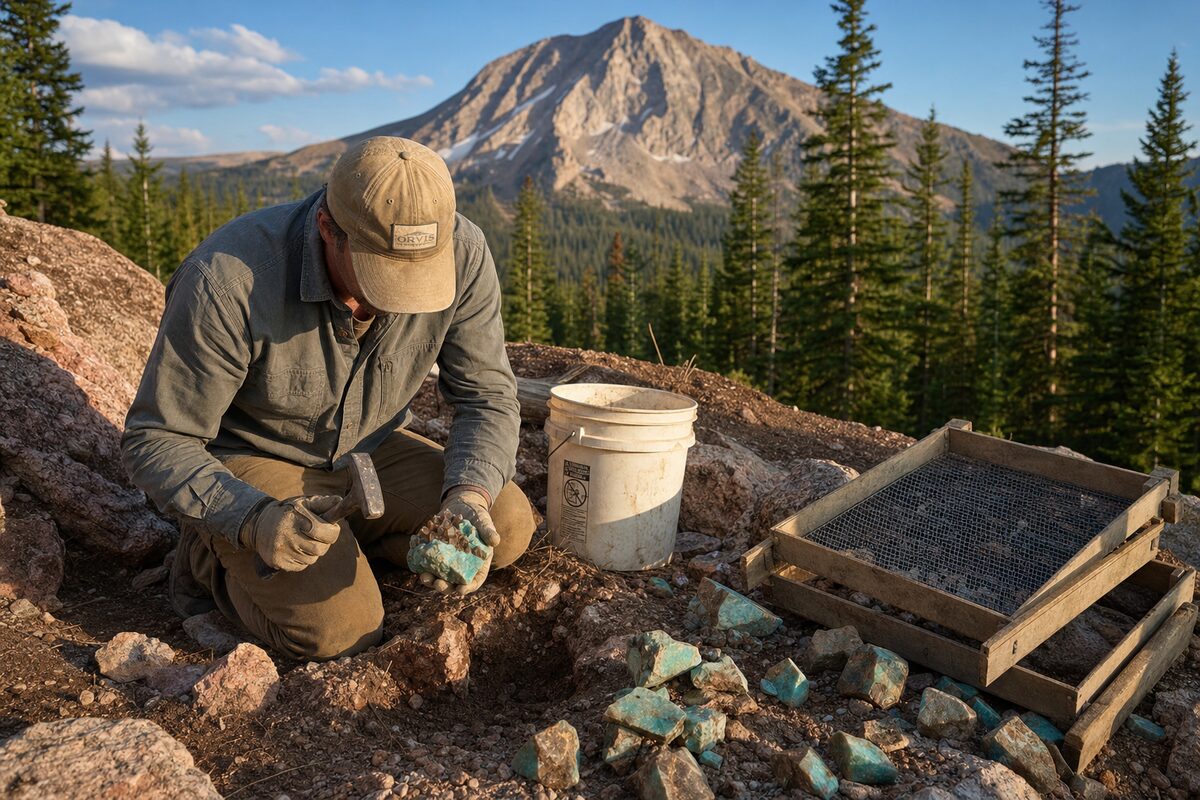
Casual use is the lane most recreational prospectors operate in. Under 43 CFR 3809.5, this includes:
- Hand panning and non-motorized sluicing
- Collection of rock, soil, or mineral specimens with hand tools
- Metal detectors, battery-operated gold spears, and hand-operated dry washers
- Small portable suction dredges (within applicable stream regulations)
- Motorized vehicles on roads open to public use
What disqualifies you from casual use:
- Mechanized earth-moving equipment of any kind
- Truck-mounted drilling rigs
- Chemicals or explosives
- Activity that cumulatively exceeds negligible disturbance
- Any form of occupancy beyond 14 days in a 30-day period
No notice, no permit, no bond — as long as you stay within these lines. That’s the deal. The moment you exceed negligible disturbance, even with a shovel and a determined attitude, you’ve crossed into territory that requires a filing.
Practical reality: The vast majority of Colorado hobby prospectors — weekend gold panners, metal detectorists, small-suction-dredge operators on open BLM streams — operate entirely under casual use. Stick to hand tools, leave the land as you found it, and you’re likely in the clear. When in doubt, call the relevant BLM field office before you go — Colorado has seven, each with jurisdiction over different terrain.
Level 2: Notice of Intent (NOI)
When you need one: Any operation that exceeds casual use but disturbs less than five acres of surface.
Once you bring in a motorized sluice, a small excavator, a trommel, or any equipment that moves meaningful amounts of earth, you’ve left casual use behind. Under 43 CFR 3809.301, operations disturbing less than five acres require a Notice of Intent filed with the appropriate BLM field office.
What goes in the notice:
- Operator name, contact information, and qualifications
- Location of proposed operations (legal description and detailed maps tied to the public land survey system)
- Description of the type and extent of surface disturbance
- Reclamation plan describing how you’ll restore disturbed land
- Financial warranty (bond) sufficient to cover full reclamation costs
Timeline: Here’s the attractive part — a Notice is self-executing. If the BLM does not take action within 15 calendar days of receiving your complete notice, you may begin operations. BLM may also clear you sooner if review wraps up early. That 15-day window assumes your filing is complete; an incomplete notice restarts the clock.
Bonding: A financial warranty — surety bond, cash deposit, letter of credit, or similar instrument — must be submitted and accepted by BLM before you set foot on the land for anything beyond casual use. The bond amount is tied to your estimated reclamation costs, not a flat fee.
Colorado adds a layer: DRMS administers permits under the Colorado Mined Land Reclamation Act (CRS Title 34). For hardrock metal mining operations affecting five acres or less, a 110(1) Limited Impact Permit from DRMS is required in addition to the BLM notice. BLM Colorado field offices have designed forms to parallel DRMS requirements — but one filing does not cover both. Contact both agencies.
Level 3: Plan of Operations (POO)
When you need one: Any operation that disturbs more than five acres of surface, or any operation that — regardless of acreage — the BLM determines will cause significant disturbance beyond what a notice can adequately manage.
A Plan of Operations is a full environmental review package. This is commercial or semi-commercial mining territory.
What goes in a POO (43 CFR 3809.401):
- All information required in a notice, plus:
- Detailed baseline environmental data (geology, hydrology, soils, vegetation, wildlife, cultural resources)
- Analysis of potential environmental impacts under NEPA
- Detailed reclamation plan and cost estimate
- Financial warranty for full reclamation
- Mitigation measures for identified impacts
The approval process: Unlike a Notice, a POO does not self-execute. BLM has 30 days to determine whether your submitted plan is complete. Once it’s complete, BLM publishes notice and accepts public comment for at least 30 days. Then comes the environmental review — a categorical exclusion, environmental assessment (EA), or in complex cases, a full Environmental Impact Statement (EIS). Depending on complexity, this process can take months to years. Operations cannot begin until BLM formally approves the plan.
For operations over five acres: DRMS requires a full 112 Reclamation Permit. BLM Colorado has developed a joint POO/DRMS form to reduce duplicate paperwork, but both approvals are independently required. You will be navigating two agencies simultaneously.
Common Mistakes (Don’t Be That Person)
Assuming a mining claim grants unlimited surface access. An unpatented mining claim gives you possessory mineral rights — not a blank check to bulldoze. Any surface disturbance beyond casual use requires the appropriate BLM filing regardless of claim status.
Skipping the bond because the operation “seems small." The financial warranty is required before you touch the land for anything beyond casual use. No bond, no legal operation.
Forgetting state requirements. BLM and DRMS operate on parallel tracks. Federal clearance does not confer state clearance. Coordinate with both.
Underestimating cumulative disturbance. Repeated operations in the same drainage over multiple seasons can push you out of casual use even if any single outing looks minor. BLM evaluates the total footprint.
Start Here Before You Go
Most Colorado recreational prospectors are squarely in casual use. Keep your tools hand-powered, leave the land as you found it, and you’re covered.
Ready to scale up? Review our prospecting guide for claim location and filing basics, or contact us with questions about specific districts and access points. Getting the regulatory piece right upfront is a lot cheaper than cleaning up after a compliance problem.