Fairplay's Middle Fork Gold Panning Park: Reading Dredge Tailings Like a Map
Drive into Fairplay from any direction and you’ll see them: long, curving ridges of round river cobbles piled along the Middle Fork of the South Platte. They look almost natural, like ancient glacial moraines. They’re not. Those are dredge tailings, and they tell the story of how this stretch of river produced gold for nearly a century.
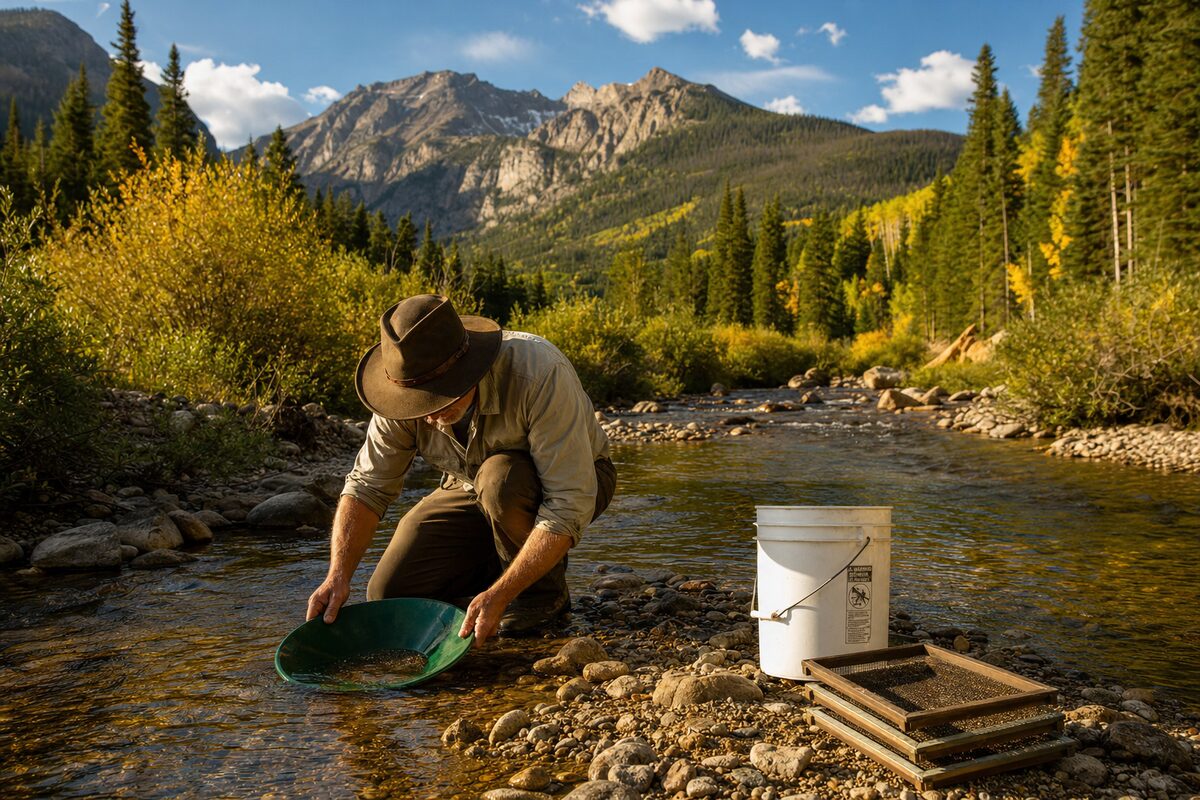
The good news for modern panners: the Town of Fairplay maintains a designated gold panning area along the Middle Fork that’s open to anyone with a $10 day permit. Once you understand what those tailings piles mean, you can stop panning randomly and start reading the river like a map.
What Bucket-Line Dredges Actually Did
Starting in 1898, bucket-line dredges began chewing through Colorado streambeds. The technology came from California and Montana, but Colorado adopted it aggressively. By 1921, construction had started on a massive four-story dredge to work the Fairplay placers, and the South Platte Dredging Company controlled 4,000 acres of ground south of town. By 1948 they were processing 14,000 cubic yards of gravel a day and pouring a gold brick every week.
A bucket-line dredge floats in its own pond. The pond moves with the dredge as it digs. Buckets at the front scoop gravel from the streambed, run it through internal sluices to recover the gold, then conveyor-belt the leftover material out the back into a stacker. The stacker drops the tailings in a curving line behind the dredge, creating those distinctive crescent-shaped piles you see today.
The Snowstorm dredge, sitting between Fairplay and Alma, is one of the last surviving examples in Colorado. The Reiling dredge near Breckenridge died in its pond and was partially preserved as a heritage site.
Here’s the thing about dredges: they were efficient at processing volume, but they weren’t perfect at recovering gold. Especially fine gold. And they couldn’t always reach bedrock. That means the tailings still hold gold, and so does the river that’s been flowing through them for the past 80+ years.
Why the Gold Is Back in the Water
When dredges processed those gravels, they piled the rejected material along the river. Snowmelt and seasonal floods have been working those tailings ever since. Every year, water erodes the piles, releasing fine gold and small flakes back into the current. That gold gets redistributed and reconcentrated in the same natural traps gold has always settled in.
This is reconcentration. The dredge took most of the easy gold a century ago, but nature has been refilling the buffet ever since. Modern panners are working a system that’s been resetting itself for generations.
The catch: most of what’s left is fine gold. Don’t go to Fairplay expecting nuggets. Expect color. With patience and good technique, you can pull respectable amounts of fine gold and small flakes from the right spots.
A Simple Sampling Workflow
Walk the panning area before you commit to a hole. Look for these features:
Inside bends. Water slows on the inside of a curve, dropping its load. The cobble bar exposed on the inside of a bend during low water is where gold accumulates.
Behind boulders. Anything that breaks the current creates a low-pressure zone downstream where heavy material drops out. Big rocks in or beside the channel are natural concentrators.
Cracks in bedrock. Wherever you can see actual bedrock exposed in the streambed, gold has been settling into the cracks for thousands of years. Use a screwdriver or crevice tool to pull material from those cracks and you’ll often find the best concentrations.
False bedrock. Even where you can’t reach actual bedrock, layers of clay or hardpan in the gravel act the same way. Gold sinks until it hits something it can’t penetrate. Pan along those clay layers.
Reconcentrated tailings. Where the river has cut through old dredge piles, the gold that was in the original material has been working its way back to a low point. Test the freshly exposed gravel near the water line.
A practical workflow:
- Take a quick test pan from each candidate spot before committing.
- Classify your material with a 1/4-inch and 1/8-inch screen. Gold concentrates with the smaller fractions.
- Work the classified fines slowly. Fine gold in Fairplay is the rule, not the exception.
- If a test pan shows multiple colors, dig deeper and pan more from that spot. If it shows nothing in two or three pans, move on.
- Mark your good spots so you can come back. The river resets after every snowmelt.
Stay Legal and Low-Impact
The panning area in Fairplay is on Town of Fairplay property along the Middle Fork as it runs through town limits. Get a permit before you dig. Full details and forms are on the Town of Fairplay website.
Permit: $10 per day, $100 per year (April through October). Children 12 and under are free with a permitted adult.
Where to buy a permit:
- Fairplay Town Hall — 901 Main Street, Fairplay. Monday–Friday, 8:30am–4:30pm. (719) 836-2622.
- High Alpine Sports — 525 Main Street, Fairplay. 7 days a week, 8am–6pm. (719) 836-0201. They also stock prospecting gear.
You can also apply online through the Town of Fairplay’s daily permit form. Call the Town Hall for weekly or seasonal options.
Rules:
- Hand tools only. Shovel and pan, plus gravity-flow sluices.
- No mechanical, electrical, or pump-powered equipment. Confiscation is on the table.
- Stay in the marked panning area. Signs designate the boundary along the Middle Fork through town.
- Take only material you believe contains gold, and no more than one gallon.
- Leave the area intact. Backfill holes. Pack out trash.
Penalties: Up to $2,650 per violation, $100 minimum. Plus restitution for any damage. They’re not joking.
The panning area is a public space. People fish, walk dogs, and bring kids through. Keep your work small, your noise down, and your impact minimal. The reason Fairplay still has a panning park is because generations of users have respected it.
Where Else to Go in Colorado
The Fairplay park is great for beginners and for anyone who wants a guaranteed-legal place to learn. But it’s heavily worked and heavily used. Once you’ve gotten comfortable with technique, Colorado has better recreational ground in less-visited areas. Our Mining Guide covers the Clear Creek, San Juan, and Chaffee County districts, and our post on Park County minerals gets into the broader regional geology.
If you’re thinking about graduating from public panning to filing your own claim, our Mining Claims 101 post breaks down BLM Casual Use, Notice of Intent, and Plan of Operations.
Questions about gold panning in Colorado? Get in touch.