Pikes Peak Pegmatites 101: What You Might Find (and How to Collect Responsibly)
Most of Colorado’s classic collector minerals — the deep blue-green amazonite, the root-beer smoky quartz, the gem topaz, the rare phenakite — come out of one geological feature. It’s the Pikes Peak Batholith, and at roughly 1,200 square miles of exposed pink granite, it’s also one of the largest rock units in the state.
If you’ve ever wanted to find an amazonite specimen with your own hands, this is where you start. Here’s the 101: how the rock got here, what you can actually find, and how to do it without breaking the law or breaking yourself.
What the Pikes Peak Batholith Actually Is
About 1.08 billion years ago, a massive volume of molten rock pushed up into the crust of what’s now central Colorado. It never reached the surface. Instead, it cooled and crystallized one to two miles down, eventually solidifying into a huge body of coarse-grained pink granite — what geologists call the Pikes Peak Batholith.
Three big things to know about it:
- It’s anorogenic. Most granite forms during mountain-building events. The Pikes Peak Batholith didn’t. It formed during continental stretching, without tectonic compression. That unusual chemistry is part of why it produces the minerals it does.
- It has three main intrusive centers. Pikes Peak proper, Buffalo Park to the north, and Lost Park to the west. Within and around these centers, smaller late-stage plutons and dikes formed — and that’s where pegmatites tend to occur.
- It contains around 128 documented mineral species. Most rock units have a handful. This one has a museum’s worth.
About 500 million years of erosion, burial, and re-exposure followed. Then 70 to 40 million years ago, the Laramide Orogeny lifted the whole region into the modern Rocky Mountains, exposing the batholith we see today.
Why Pegmatites Are the Collector’s Best Friend
When magma cools, the first minerals to crystallize lock up the most common elements. The remaining melt gets progressively richer in water, fluorine, lithium, beryllium, and other “incompatible” elements. By the time the last few percent of the magma freezes, you have a chemistry that’s primed to grow large, well-formed crystals — sometimes inside open gas-pocket cavities called miarolitic cavities.
These late-stage, coarse-grained pockets and dikes are pegmatites. In the Pikes Peak Batholith, they cluster around the edges of the intrusive centers and along late-stage sodic plutons. The classic Colorado mineral association comes out of these pockets: blue-green amazonite (microcline feldspar with trace lead), smoky quartz (darkened by natural radiation from the surrounding granite), and sometimes fluorite, topaz, or beryl in the same cavity.
What You Might Find
Realistic expectations for a beginner working the Pikes Peak region:
- Smoky Quartz. The most common collector mineral in the batholith. Color ranges from pale tan to nearly black. Crystals can be huge — foot-long pieces aren’t unusual.
- Amazonite. Blue-green microcline. Color varies wildly by pocket. Sky-blue is more common than the deep teal seen in museum specimens.
- Cleavelandite (Albite). White, platy feldspar. Often grows alongside or under amazonite.
- Fluorite. Purple, green, or colorless cubic crystals. Less common than amazonite-smoky combinations, but reliable in some pockets.
- Topaz. White, sherry, or pale blue gem-quality crystals, especially in the Tarryall Mountains to the west.
- Phenakite. Rare beryllium silicate. Tiny, gem-quality, and the holy grail of Pikes Peak pegmatite collecting.
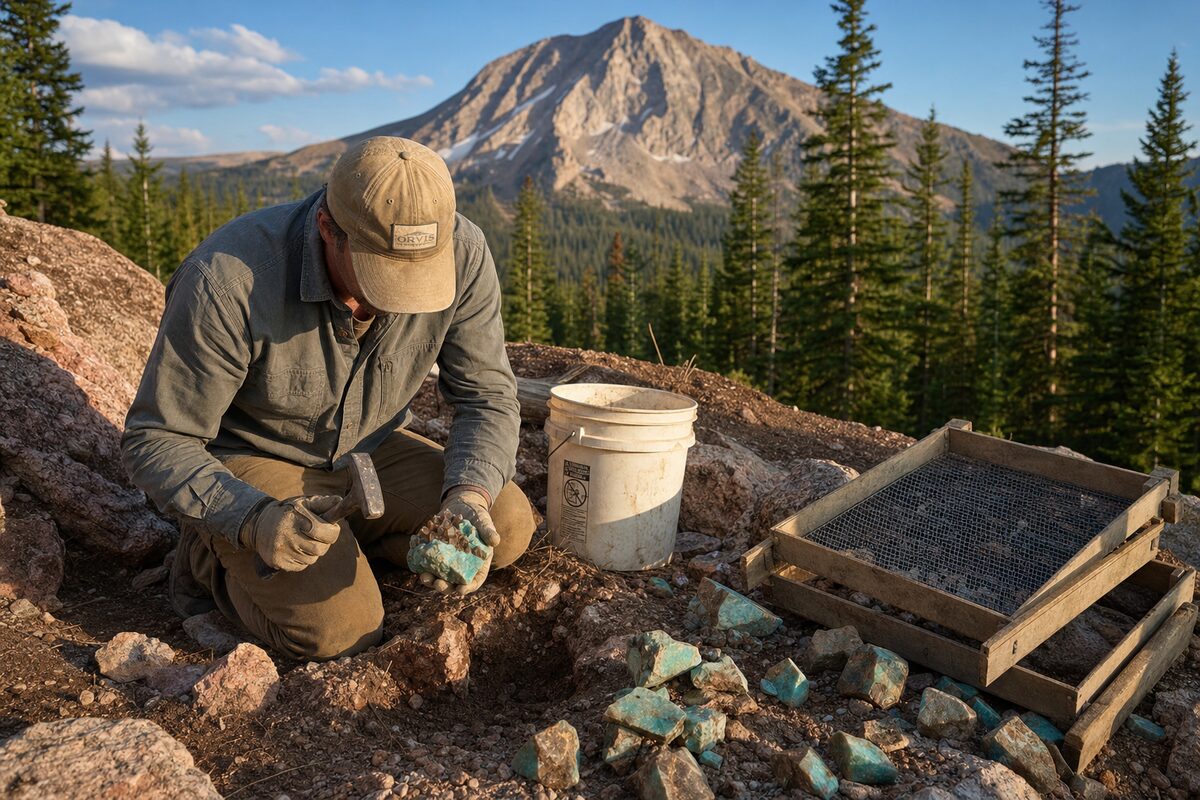
Realistic expectations for what you’ll actually take home on your first trip: surface float of broken amazonite or smoky quartz from old mine dumps, classifier screen finds, and maybe a chip or two of fluorite. Pocket finds happen, but they happen to people who put in many days and know the ground well.
The Collecting Areas — and Their Access Reality
This is the part most rockhounding articles get wrong. The famous spots are mostly not freely open. Here’s the honest picture:
Crystal Peak District (Lake George area, Teller / Park counties)
The most famous amazonite locality in the world. Most of the productive ground is claimed. The well-known Pinnacle 5 Minerals (Joseph Dorris) claims operate club-only digs in June and July — you visit through an organized Colorado mineral club, not by showing up. Pinnacle 5 explicitly states the Forest Service tickets unauthorized visitors. If you find red- and white-topped posts in the woods up there, that’s an active claim.
The Lake George Gem and Mineral Club is the cleanest path into this area. Membership opens up organized field trips and connections to claim holders who allow guests.
Crystal Park (Manitou Springs)
Famous for dark blue amazonite with phenakite and topaz. Now a gated private community. The only legal way in is to own property there or be a guest of someone who does. The “back way” — a steep hike up from the east — was historically possible but goes through difficult terrain and requires verifying current land status.
Glen Cove (Pikes Peak north side)
Topaz, smoky quartz, and some amazonite. Located on the Pikes Peak Highway corridor at around 11,500 feet. Historically collected with ropes off the cliffs by serious mineral collectors. Casual access is impractical and the corridor is now heavily regulated. Don’t plan a trip around this one.
Tarryall Mountains (Park County)
The state’s best gem topaz, plus smoky quartz. A mix of old claims, Forest Service ground, and private property. Spruce Grove Campground has historically been the main access point with a fee and a steep hike. Some areas around Pilot Peak have newer claims.
Devil’s Head (Pike National Forest, Douglas County)
Smoky quartz and topaz. Pegmatite ground on USFS land. Historically open to hand-tool collecting, but verify current status with the Pike-San Isabel National Forest district office before you go.
Wigwam Creek
Historic claim of the Denver Gem and Mineral Guild. Produced the largest gem topaz crystals ever found in Colorado around 20 years ago. Access is through the Guild — another reason to join a club.
The Legal Framework You Actually Need to Know
Three rules cover most of what beginners need:
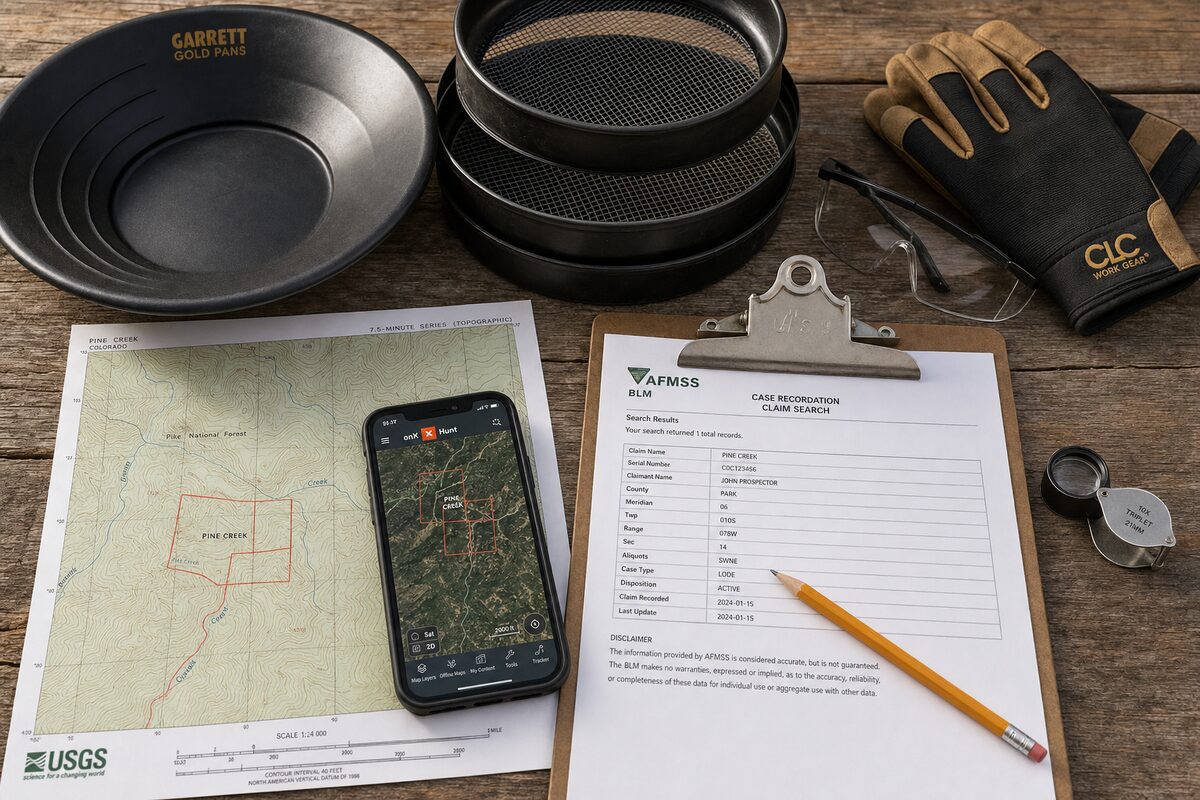
1. Surface collection on BLM land (no active claim) is generally legal for personal, non-commercial use. Hand tools only. Reasonable amounts (most field guides cap it around 25 pounds per year). Don’t dig into bedrock with machinery, don’t sell what you find commercially. Verify the parcel is open to mineral entry through the BLM’s LR2000 system before you commit.
2. National Forest collecting (USFS, including Pike-San Isabel) varies by district. The PSICC doesn’t have formally designated collecting areas. General policy allows hand-tool, surface, personal-use collection unless posted otherwise, but you should check with the local ranger district before any organized trip. Don’t disturb cultural resources or sensitive habitat.
3. Active mining claims are off-limits without written permission. Period. Claim posts and notices are legally binding. Trespassing on a claim — even one that looks abandoned — can result in citations, lawsuits, and confiscation of specimens. If you see metal claim posts, ribbons, or stake markers, walk the other way.
For a deeper look at the three operational tiers above casual collection — Notice of Intent and Plan of Operations — see our Mining Claims 101 post.
How to Plan a Responsible First Trip
Here’s a sequence that actually works for a beginner:
Join a club first. The Lake George Gem and Mineral Club, Colorado Springs Mineralogical Society, or Denver Gem and Mineral Guild all run organized field trips, have access to claims, and will get you onto productive ground with people who know how to read it. This is by far the fastest path from “I want to collect amazonite” to actually collecting amazonite.
Start with old dumps, not virgin ground. Surface float and material on old mine dumps yields finds with minimal effort and zero risk of opening unstable workings. Beginners who immediately try to dig pockets usually end up with nothing but blisters.
Carry the right gear. A rock hammer, a 10x loupe, 1/4-inch and 1/8-inch classifier screens, gloves, safety glasses, a small pick, a screwdriver for delicate work, a notebook, and water. A hard hat if you’re near any kind of slope or excavation. Skip the heavy machinery and the explosives.
Verify land status before every trip. BLM LR2000 for federal land. Teller County and Park County assessor records for private boundaries. Don’t trust online “free collecting” lists — they go stale fast.
Leave no trace. Fill your holes. Pack out trash, including trash that wasn’t yours. Don’t cut trees. Don’t roll loose rocks downhill. The reason these areas are still open is because previous collectors didn’t trash them.
Watch the weather and the altitude. Most of the productive ground sits between 8,000 and 11,000 feet. Afternoon thunderstorms are nearly daily in summer. Get above treeline early, get off by noon, hydrate aggressively.
Where to Go Next
Pikes Peak pegmatites are some of the most productive collecting ground in North America when you have access, and some of the most frustrating ground in North America when you don’t. The shortest path between those two states is a club membership and one organized field trip. Everything after that gets easier.
For more on the specific Lake George area, see our deep-dive on Lake George Amazonite + Smoky Quartz. For broader Park County context, Park County Minerals covers the geology and culture of the region. And if you’re new to Colorado mining law in general, our Mining Guide is the place to start.
Questions about responsible Pikes Peak collecting or club membership? Get in touch.